
Conversations with artist and professor Cristiano Nogueira, that capture the rare and wonderful moments at the Atelier Bandeira de Mello, Rio de Janeiro.
* * * * * * * * * * * * * * * * * * * *
Mestre Lydio Bandeira de Mello was an exceptional figurative artist, who I unfortunately never had the chance to meet, as he passed away at the age of 94, just two months before I began taking life model drawing classes at his atelier in January 2024.
Cristiano Nogueira, who studied with and assisted Mestre Bandeira, has graciously taken his turn to be the professor at the Atelier, and pass on some of the wisdom and techniques that he learned under the Mestre’s tutelage.
The line is sometimes strong, sometimes weak, sometimes very defined, and sometimes fleeting.
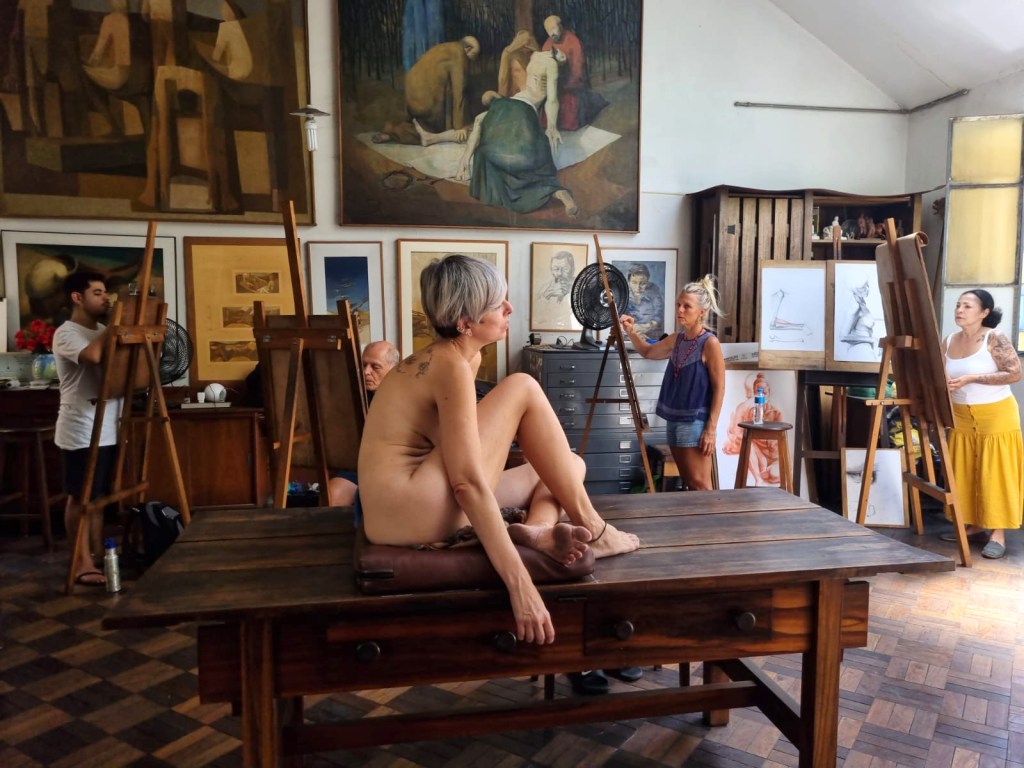
The Atelier is located on the top floor of an old European-style building in Laranjeiras, Rio de Janeiro.
A space that values drawing and artistic traditions, and has not lost any of its authenticity, as the energetic imprint of Mestre Bandeira and the many artists who have faithfully walked up the flights of stairs, to practice, for over 70 years, is still very much alive.
To me, when I come to class, the atmosphere feels like I have walked into an artist’s painting that has stood the test of time.
Recently I took the opportunity to ask Cristiano a few questions, to learn more about the story of the Atelier and the energy of the Mestre that still influences and inspires everyone who comes there today.
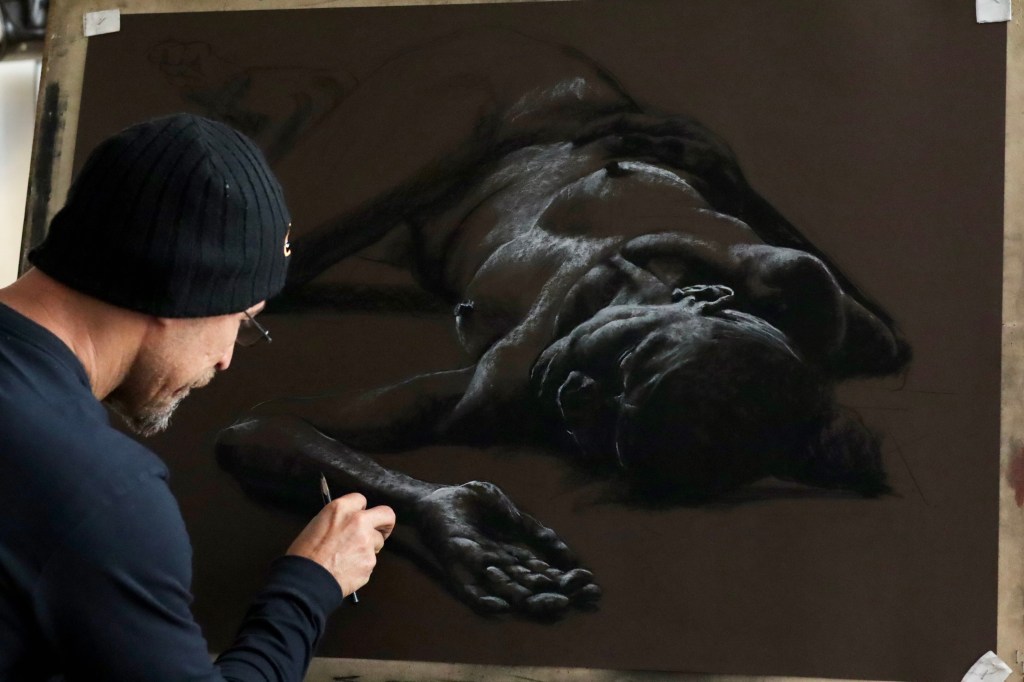
How did you start to study with the Mestre at the Atelier?
In 2012, I was in college taking painting classes at the Belas Artes School at UFRJ, and many people were already talking about Mestre Bandeira.
A friend of mine who I was studying with said, ‘Man, you have to meet Bandeira, you have to see Bandeira’s work.’ So I said, ‘Ok, let’s go!’.
So when I got here, I soon dropped everything I was doing and dedicated myself completely to the Atelier. I remember I started on a Monday night. Maybe by the second or third month, I was already coming three times. It didn’t take long before I was coming every day.
What do you remember from those early days of being a student here? What was the vibe?
I remember before we entered, he’d say, ‘Hey, come in quietly, come in slowly, come in with an A3 notebook, or a A3 sheet’. Then he’d tell you if you can stay or not.
But it went ok. On the first day he’d take a good look at the drawing and then say, “yeah, ok, let’s go, come in next week.” Then he would immediately tell you to bring a large sheet of paper the following week. And that’s intimidating, right? A sheet measuring 1 metre x 70 cm when you’ve never drawn on something large like that.
Most people start holding the charcoal the way you hold a pen, but you have to draw with your shoulder. Not with a fist. Holding your material differently already starts to change your work.
So, I used my shoulder to draw on a one-meter by 70 cm sheet. You have to get used to it. On the easel, drawing standing up, drawing with shoulder movement, looking, approaching, moving away. And that’s how it was. These are things I learned from him.
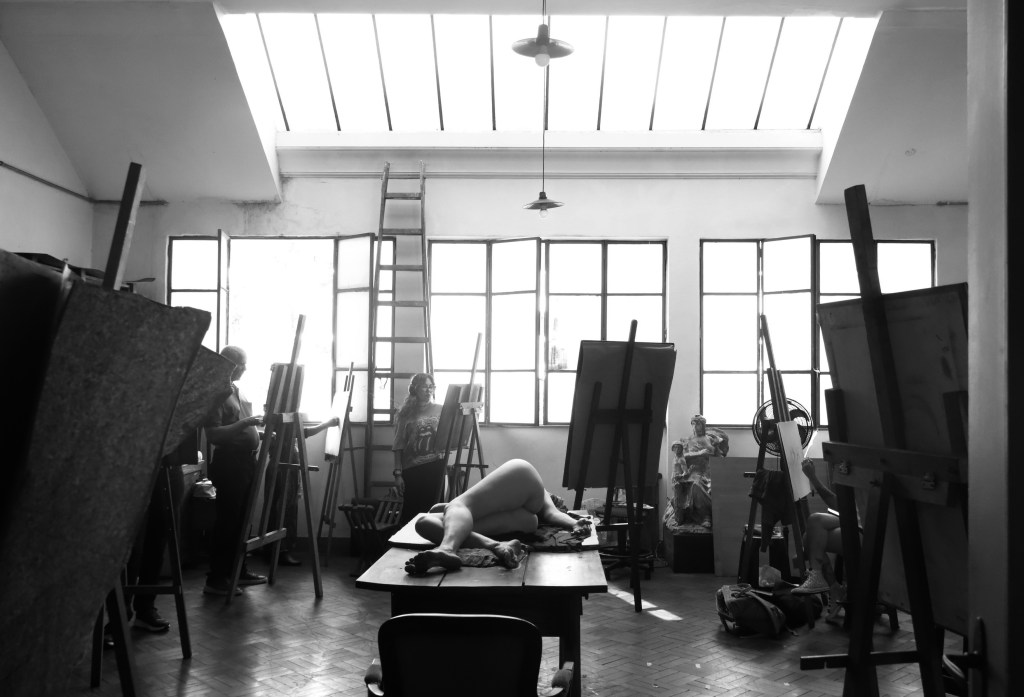
Mestre Bandeira was born in June 1929, in Mina Gerais (Brasil) and he moved to Rio de Janeiro to study at the Escola Nacional de Belas Artes and graduated in 1951. It was around this time that he was invited to visit the Atelier by the original owner, Brazilian artist Manuel Santiago.
I read that the Atelier was part of a preplanned artist studio prior to the building being constructed. Do you know anything more about this?
Manuel Santiago went to study in France, he stayed there for four or five years, and when he returned to Brazil in 1934, he decided to build an atelier for himself, based on one he had studied at in France.
So he brought back the building plans with him for the project, to create a spacious artist’s atelier on the roof with a skylight, mezzanine… here, at that time, in Rio de Janeiro, he had the opportunity to choose a piece of land. That’s difficult today, isn’t it?
At that time, he looked for a place where he could design this atelier so the light that would come through the skylight would be ideal for an artist giving life model drawing classes… from sunrise until sunset, the light would illuminate the space throughout the day.
So he brought the blueprint and built this four-story building, with the fourth floor being the penthouse, the atelier.
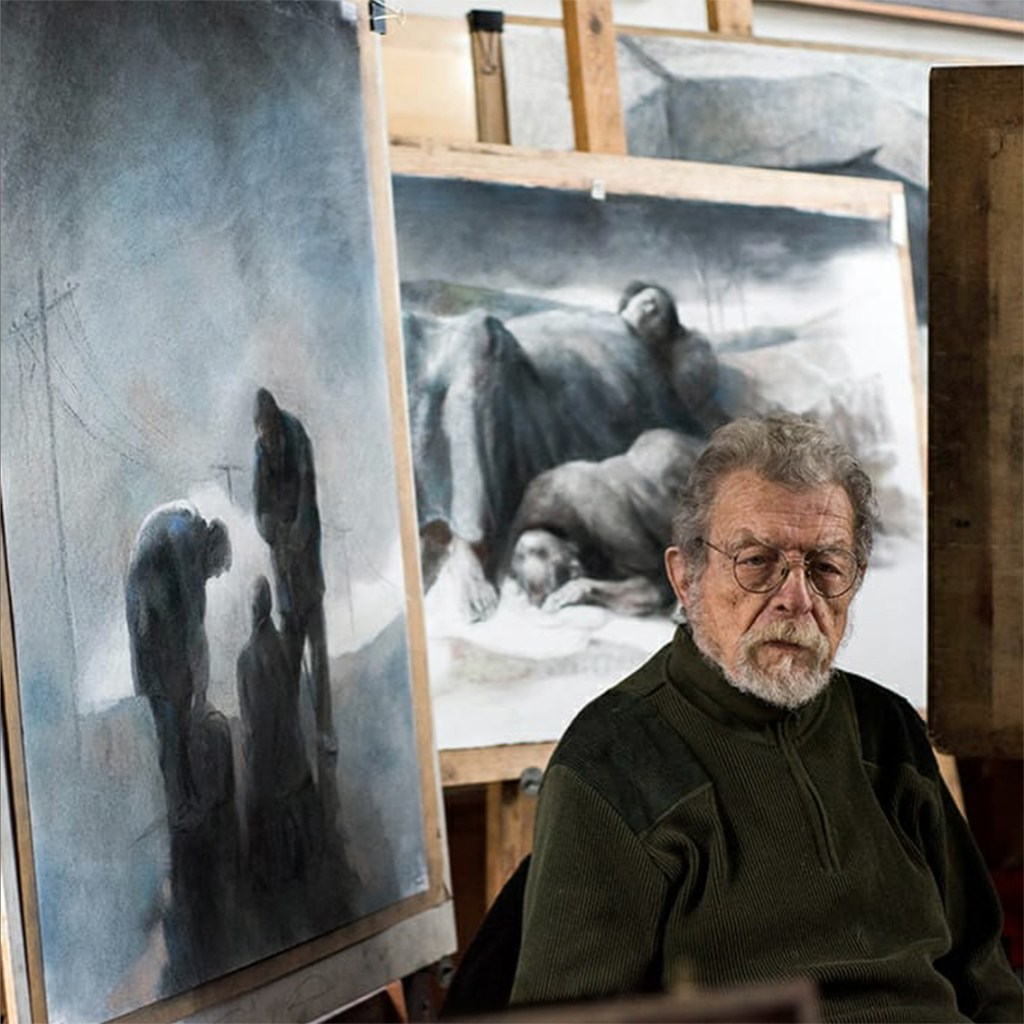
When the Mestre passed away in November 2023. How did this impact you?
When he passed away. We were in the end of the pandemic period. I mean, it was over but it was a process, right?
But when things started to open up, then people started to call me. They knew I had direct contact with Bandeira, as I was already helping him in the atelier and they asked if he was going to come back.
He wasn’t afraid of leaving the house, but it was the difficulty to go up to the Atelier because the building has four floors and there’s no elevator. That was a challenge for his return, the stairs. But it was his daily exercise.
Because before the pandemic, he was 92 years old, he went up, sometimes he came down twice for lunch. But after the pandemic we didn’t come straight back here.
I wanted him to leave the house. I wanted him to come back to teaching at his Atelier, but the way to get him back was to first get him out of the house.
I found a space, they all helped me find a space, a beautiful space in Botafogo, on the ground floor and he agreed to teach there.
So I think we stayed there for a month or two, with a few meetings. And it didn’t take long for him to get the hang of it.
Then during that time I didn’t push too hard, but I would ask ‘when are we going back to the atelier?’
And on the day we came back here, it came from him, he said ‘I think it’s time to go there to the Atelier’.
‘Yeah, let’s go’, I said.
The atelier had been closed for two years and when we walked through that door, it was really emotional. When he opened the door, he said, ‘oh, how I missed that smell.’
Because the Atelier has a smell, right?
That atelier smell, which is wonderful, that still exists today. That really made him miss it and gave him the strength to return. So the classes returned but they weren’t everyday like before.
We were in class, when he passed away.
During class time… I was giving a class when he passed away.
So.
Yeah.
I couldn’t think about anything.
I was just thinking that I lost my teacher, I lost my friend.
But…
Some people came to ask me if I could continue teaching classes, and his son also came to ask if I could.
It wasn’t an easy decision, no, but I think it was a wonderful way to keep this atelier alive, to keep Bandeira alive among us, to talk about him now, to talk to young people.
There are people here, man, that don’t even know about Bandeira, but we talk about him so much. I think they know him now, and that’s thanks to this atelier being open.
It’s really good it’s open, it’s really good that in almost every class I can show the Mestre’s work, you know. It’s really inspiring to show those works, and it’s a way to know Bandeira, to show the works of a guy who drew a lot, painted a lot.
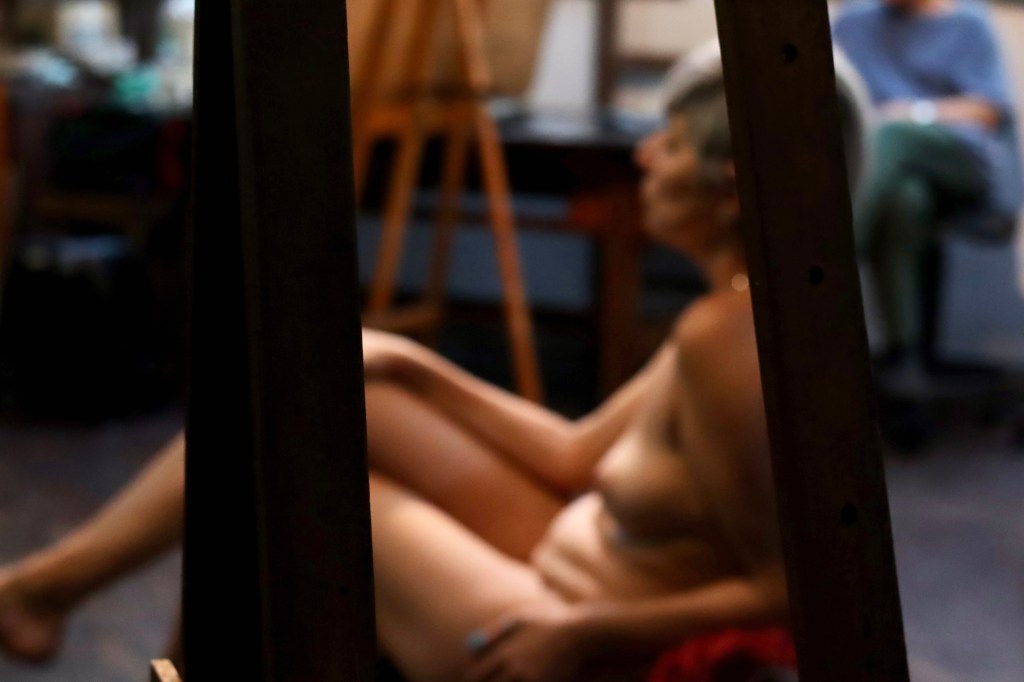
Those who don’t know how to draw what they’re seeing won’t know how to draw what they’re thinking. So, here we have a living model, observe.
Mestre Bandeira
What were some of the things you remember the Mestre always saying?
’Draw what you are seeing. What you are seeing, I can help you with. What you are thinking – I don’t know if what you are thinking, is what is coming out on the paper‘.
That was the first thing, his phrase.
Another thing he talked about a lot was the order of things.
First, composition. How are you going to place the human figure in that space on the paper. So, composition, proportion, that’s the order you must follow.
A student might say,’ I want to do a detail study’. Then draw a detail, a part of the human figure because you want to, not because you drew it by accident.
So, this control of space, the mastery of space, is very important for beginning students, experienced students, for any student.
Mastery of space was the fundamental point.
What else did you learn from the Mestre?
Bandeira. He drew a lot, painted a lot. But above all, he was an excellent teacher.
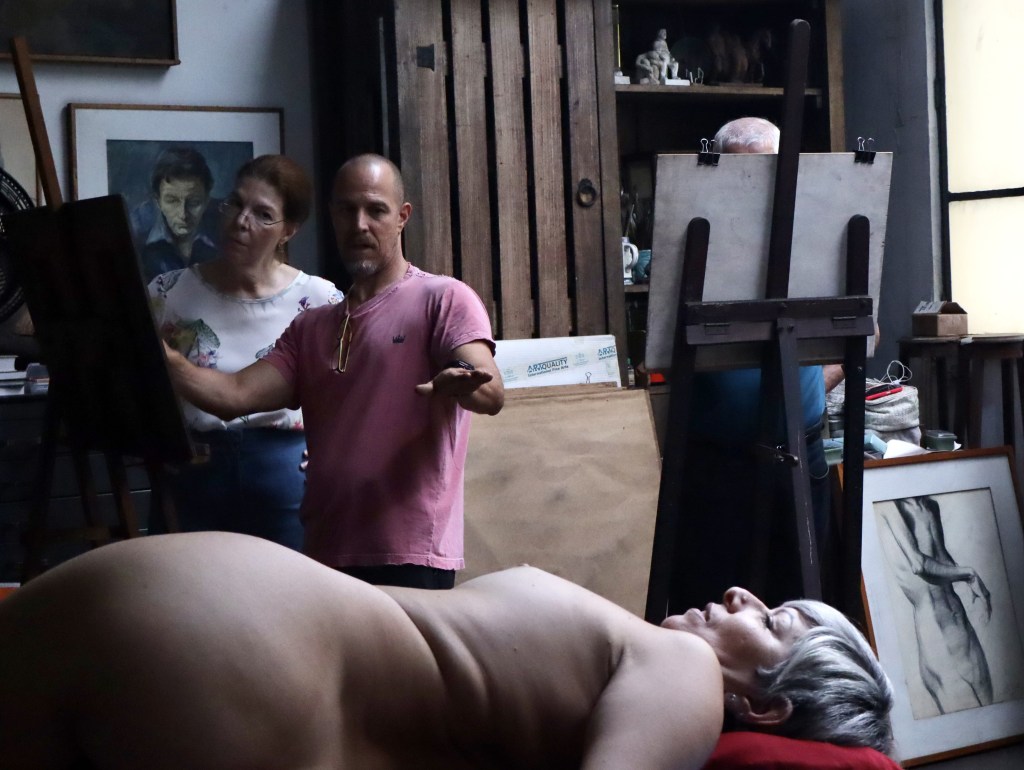
During class, I followed him, helping him so he could move around more easily and I began to realize that by listening to what he said to the students, I was learning.
Everything has a right time to be said. Everything has a right time to be critiqued.
We don’t have a formula. I don’t know everything, I don’t know how or when the right time is. Man, I don’t know. You look at the student’s drawing. You have to know their capacity, know what, how far they can go, and give that push. Because pushing without knowing if they can get there will also make them fall.
It’s okay to fall, you can get back up. But hey, they’re not here just to be taking criticism. They’re here to progress, to make the work evolve.
Then you have to know what the next step is. So walking with him, I walked with him to all the easels. We’d take a break and then he’d do another round.
At that point, I went to all the easels with him and began to understand a little bit of what he wanted in the evolution of these works, that was really important to me.
Do you have a funny or interesting story to tell us about the atelier?
Some things were funny here. One of them was that every Monday night we’d leave tired. Class ended at 9:00pm and every Monday the old man would come down singing the same song: ‘I want mocotó – put mocotó on my plate’
Mocotó (Brazilian stew made with cow’s feet) is awesome. I’m like, ‘That’s not possible, old master. I’m tired here, man.’
But he’d go down the stairs and still be singing every Monday.
Then one time we were here drawing, and it started pouring down rain, really heavily, and he was like, ‘I’m going to stay here drawing today and you’re going to stay.’
I said, ‘Damn, I can’t wait to go home.’ I said, ‘Oh my God, this is crazy.’
Okay, let’s stay here drawing.
Then came a certain time in the night when the rain stopped. And we finally had a chance to leave. But he would stay here drawing, man, nonstop. Fully Battery!
Are their any plans for the atelier to change at all in the near future?
There’s a desire to transform the Instituto Bandeira de Mello, and let’s hope that happens, right? I think it’s important to keep the atelier busy, with movement every day. I think it’s important.
What I think, is that what we’re living right now, with the students, these meetings, these classes. It’s a rare moment. Tomorrow or the day after, everything might end up in a museum, or some people might start buying all these works. Today, the access is ours, those who frequent the atelier.
Cristiano Nogueira
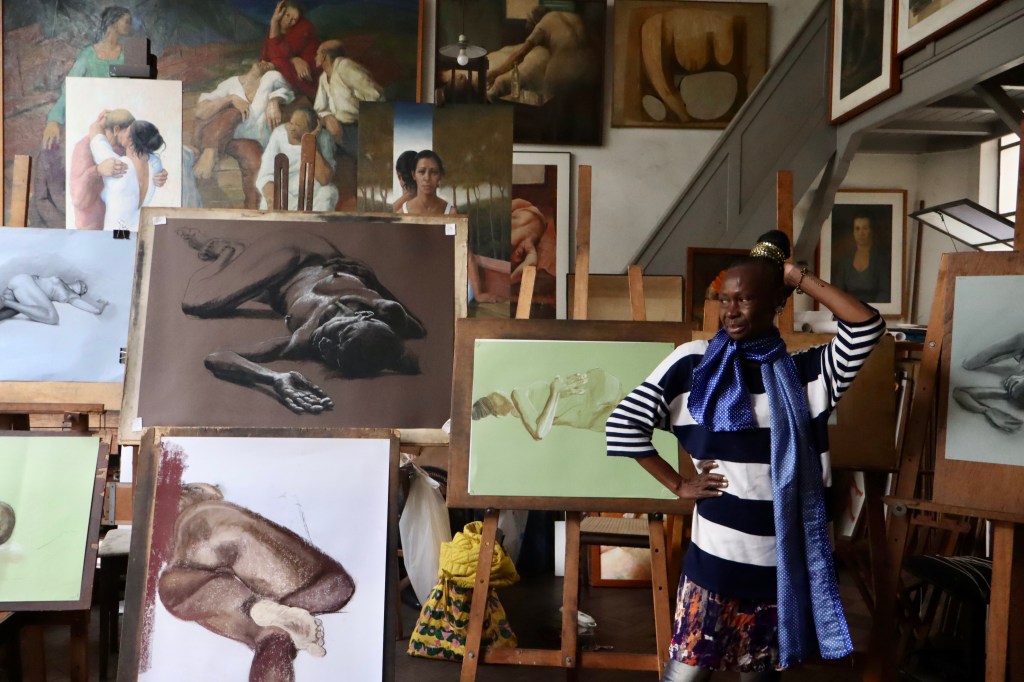
Ateliê Bandeira de Mello
Rua das Laranjeiras 34, Laranjeiras, Rio de Janeiro, 22240-000
See more about the Atelier
https://www.instagram.com/atelierbandeirademello/
See more about the works of Mestre Bandeira https://www.instagram.com/lydiobandeirademello/
Many thanks to Cristiano Nogueira (Gratidão por tudo)
https://www.instagram.com/eucristianonogueira/
Many thanks to model Lais Aszmann
https://www.instagram.com/laisaszmannmodelartlivevideo/
All images copyright Jacq Laurenson art.

Leave a Reply